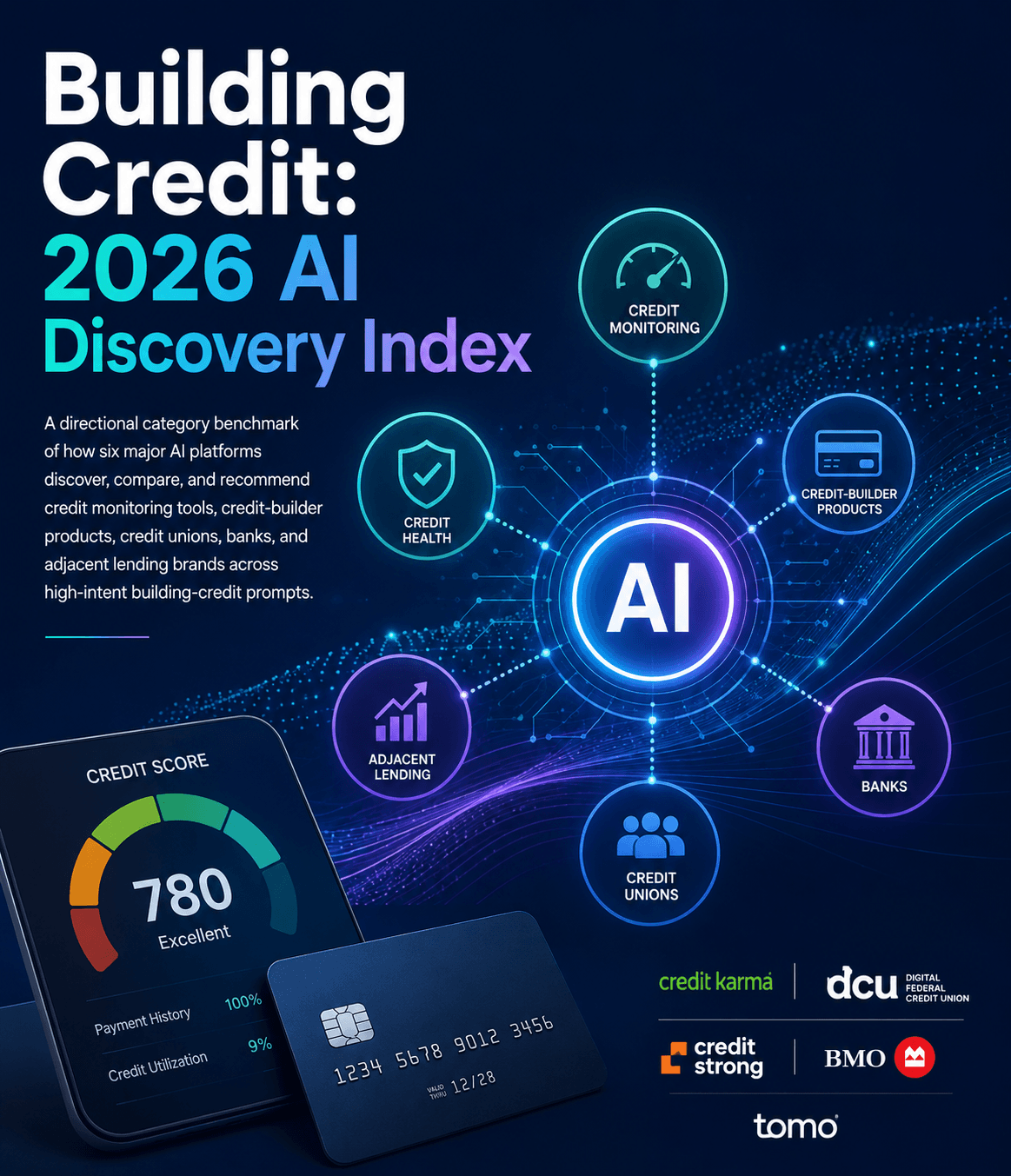
Building Credit: 2026 AI Discovery Index
A directional category benchmark of how six major AI platforms discover, compare, and recommend credit monitoring tools, credit-builder products, credit unions, banks, and adjacent lending brands across high-intent building-credit prompts.
May 2026
Reporting month
6
AI platforms tracked
3
High-intent prompt clusters observed
5
Tracked finance brands
Credit Karma, BMO Bank, Credit Strong, Digital Federal Credit Union, Tomo
Tracked brand set
On this page
- 01Answer Capsule
- 02Executive Summary
- 03The AI Discovery Shift in Building Credit
- 04Directional Category Leaders
- 05The Buying Moments That Now Decide the Category
- 06Why Recommendation Power Is Concentrating
- 07The Category’s Most Visible Warning Sign
- 08What This Means for the Category
- 09What This Public Benchmark Does Not Include
- 10Methodology and Disclaimers
- 11CTA
Answer Capsule
In the May 2026 Building Credit snapshot, AI recommendation power splits into two markets. Credit Karma appears strongest in credit monitoring and free credit-health app moments, while Credit Strong and Digital Federal Credit Union are stronger when the user asks for products that can actively build credit. BMO Bank and Tomo surface mainly in adjacent banking, HELOC, mortgage, or lending contexts rather than as core building-credit shortlist leaders.
Executive Summary
AI discovery in building credit is not organizing around one universal category winner.
It is splitting the consumer journey into separate jobs.
One job is monitoring credit: checking scores, tracking changes, understanding reports, and using free personal finance apps. In those moments, Credit Karma has the clearest public benchmark signal. It appears as a recommended option in credit monitoring prompts, including “best site to monitor your credit” and “best credit monitoring service” style questions.
A second job is actively building credit: opening a secured card, choosing a credit-builder loan, establishing payment history, or improving credit mix. In those moments, the AI answer set shifts. Credit Strong and Digital Federal Credit Union become more relevant because they are framed around credit-builder products, credit union loans, secured-card contexts, or low-cost credit-building paths. In one observed credit-building product prompt, Digital Federal Credit Union was framed around low APR credit-builder loans, while Credit Strong was framed around larger credit-building lines and credit mix.
A third job is adjacent financial qualification: auto loans, mortgages, HELOCs, credit union accounts, business banking, and broader borrowing. Digital Federal Credit Union benefits heavily here because AI systems repeatedly recognize DCU as a credit-union and lending option. BMO Bank and Tomo appear more in these adjacent lanes than in core credit-building recommendations. That matters because adjacency can inflate visibility without proving category leadership.
The category’s central lesson is simple:
AI systems do not treat “building credit” as one market. They route the user into a product lane.
That routing determines who becomes eligible for the shortlist.
The AI Discovery Shift in Building Credit
Traditional SEO can make building credit look like a single content category.
AI discovery does not.
A consumer might ask how to build credit with no credit, what app to use to monitor a score, which credit-builder loan is best, which secured card helps fastest, which credit union is best for a credit card, or how to start credit for free. Those questions sound related. But AI systems often answer them as different commercial problems.
That creates a new competitive structure.
Credit monitoring tools win when the user wants visibility and education. Credit-builder loan products win when the user wants an account that reports payment history. Credit unions win when the user asks about low-cost secured cards, credit-builder loans, or lending options. Banks and mortgage providers may appear when the prompt drifts toward borrowing, HELOCs, auto loans, or home financing.
This is why presence and recommendation power must be separated.
A brand can appear as a helpful app, a cited source, a score-tracking tool, a bank, a lender, a mortgage marketplace, or a credit union. But only some of those appearances are recommendation-level outcomes. In AI discovery, the important question is not only whether a brand is visible. It is whether the AI system advances that brand as the right solution for the user’s credit-building problem.
The strongest category signal is not who is mentioned.
It is who gets assigned the job.
Directional Category Leaders
Brand | Directional AI role | Key public signal |
Credit Karma | Credit monitoring and free credit-health app leader | Strongest visible fit for score tracking, monitoring, and free app prompts |
Digital Federal Credit Union | Low-cost credit union and credit-builder loan specialist | Repeatedly framed around credit union products, low-cost loan options, and adjacent banking use cases |
Credit Strong | Credit-builder product specialist | Shows up when prompts move from monitoring into active credit-building products and credit mix |
BMO Bank | Adjacent banking and HELOC presence | Appears more in broader banking or lending contexts than in core credit-building recommendations |
Tomo | Mortgage and alternative lending adjacency | Appears in mortgage marketplace contexts, but not as a central building-credit recommendation |
Credit Karma’s advantage is clearest in the monitoring lane. When the prompt asks for a site, app, or service to monitor credit, Credit Karma is a natural AI answer because its category role is easy to summarize: free credit scores, monitoring, and credit-health tracking. The packet includes examples where Credit Karma is recommended for credit monitoring, but also examples where it is mentioned only as a way to watch progress rather than as a true credit-building product.
Digital Federal Credit Union’s signal is different. DCU does not simply appear as a monitoring app. It appears as a product provider in credit union, loan, secured card, savings, checking, auto loan, and business account contexts. That gives it broader financial-product eligibility. In core credit-building prompts, DCU’s strongest public framing is low-cost credit-builder loan or secured-card adjacency.
Credit Strong appears narrower but more directly tied to the building-credit job. Its public signal is strongest when AI systems interpret the consumer need as requiring a product designed to create payment history or improve credit mix. That is commercially different from “check your score.” It is closer to the point where a user may open an account.
BMO Bank and Tomo are not absent from the broader financial prompt universe. But the public packet suggests that their visible roles are more adjacent. BMO appears in banking and HELOC-related contexts. Tomo appears in mortgage-marketplace contexts. Those are valuable financial discovery moments, but they are not the same as category control in building-credit recommendations.
The Buying Moments That Now Decide the Category
The public snapshot points to four commercially important buying moments.
The first is credit monitoring and credit-score tracking. This is where Credit Karma is most clearly advantaged. Prompts such as “best site to monitor your credit,” “best credit monitoring service,” and “best credit card app” tend to reward brands that AI systems can describe as free, familiar, and useful for ongoing credit visibility. In this lane, Credit Karma is easy for AI systems to recommend.
The second is active credit-building product selection. This is where the category changes. Users asking about credit-builder loans, secured cards, or how to build credit from scratch are not only looking for education. They are looking for a mechanism. Credit Strong and Digital Federal Credit Union become stronger because they can be framed as products or institutions that help establish credit history.
The third is free or no-credit starting points. These prompts are high-friction because the user often wants a no-cost path. AI answers may recommend responsible steps before naming products: become an authorized user, use a secured card, report rent, pay on time, or monitor progress. In one observed “start credit with no credit for free” style prompt, Credit Karma was suggested as a way to watch score progress, but not treated as a buying-intent recommendation for a product.
The fourth is adjacent financial-product discovery. Credit unions, auto loans, savings accounts, business accounts, mortgages, and HELOCs all appear in the surrounding prompt environment. This can help brands like DCU, BMO, and Tomo gain visibility, but it also complicates interpretation. A brand may look visible because the prompt universe includes adjacent banking and borrowing moments, not because it owns the core building-credit journey.
That distinction matters.
The user may ask about building credit. The AI system may answer with a monitoring app, a secured card, a credit-builder loan, a credit union, or a bank.
The brand that wins depends on how the AI system classifies the job.
Why Recommendation Power Is Concentrating
Building credit is a trust-heavy financial category. AI systems appear to lean heavily on third-party source environments rather than only brand-owned pages.
The observed citation layer includes editorial finance publishers, review-style comparison pages, official product pages, app-store pages, credit union pages, education resources, and community forums. Examples in the packet include Bankrate, NerdWallet, WalletHub, CNBC, Forbes, Money, Finder, LendEDU, Edvisors, Firstcard, Kikoff, Google Play, myFICO, Zillow, Reddit, and official credit union or bank domains.
That mix explains the category split.
Credit Karma benefits when editorial and app-comparison sources frame it as a free monitoring or credit-health tool.
Credit Strong benefits when review and education sources discuss credit-builder products, credit mix, or account structures designed for building credit.
Digital Federal Credit Union benefits when editorial and official sources frame DCU as a low-cost credit union option, especially in credit-builder loan, secured-card, banking, and lending contexts.
BMO and Tomo benefit from adjacent evidence environments, but those environments do not necessarily translate into building-credit shortlist eligibility.
This is not a pure citation-count market.
A cited source can support the answer without making a brand the recommendation. An official page can provide facts without winning a shortlist. A brand can be visible because it is part of the financial ecosystem, not because AI systems believe it is the best answer for building credit.
Recommendation power concentrates when the evidence layer repeatedly assigns a brand a specific role.
The Category’s Most Visible Warning Sign
The most visible warning sign is the monitoring trap.
Credit Karma is the clearest example.
The brand has strong AI fit for credit monitoring. It is easy to recommend when the user asks for a free app, a credit score site, or a way to track progress. But monitoring credit is not the same as building credit. In at least one observed no-credit/free starting-point prompt, Credit Karma was mentioned positively as a tool to watch progress, but it was excluded from the valid recommendation layer because the answer did not present it as the product that builds credit.
That distinction is commercially important.
A consumer may begin with “How do I build credit?” and receive a list of steps. A monitoring app may appear in the answer. But the account-opening action may go to a secured card, a credit-builder loan, a rent-reporting product, or a credit union.
In older SEO reporting, the monitoring brand might look strong because it appears often.
In AI discovery, it may still lose the product-choice moment.
The same risk applies to banks and mortgage-adjacent brands. BMO and Tomo may surface in financial answers, but if the prompt is interpreted as credit-builder product selection, they may not become eligible. Visibility in adjacent finance is not the same as recommendation control in building credit.
The public lesson is direct:
A brand can help the user understand credit and still fail to become the credit-building action.
What This Means for the Category
Building-credit brands need to compete on problem ownership, not just brand awareness.
Credit monitoring brands need to make clear when they are more than passive tracking tools. If AI systems primarily frame them as score watchers, they may remain visible but commercially downstream from the actual product decision.
Credit-builder loan and secured-card providers need evidence that is easy for AI systems to reuse: who the product is for, how it reports, what it costs, what risks exist, what bureaus are involved, and how it compares with secured cards, rent reporting, authorized-user strategies, and free education paths.
Credit unions need to separate their building-credit products from their broader banking visibility. DCU’s public signal shows the upside of broad positive financial-product framing, but it also shows why category specificity matters. A credit union can be recommended for savings, checking, auto loans, and business accounts while still needing clearer ownership of the credit-building lane.
Banks and mortgage-adjacent providers need to decide whether building credit is a core acquisition path or only an adjacent content topic. If it is core, generic banking pages will not be enough. The AI answer needs to know exactly when that brand is the right choice for someone with no credit, thin credit, damaged credit, or a specific borrowing goal.
The broader category consequence is this:
AI systems are turning credit education into product routing.
That means the winner is not always the best-known financial brand. It is the brand that AI systems can confidently map to the user’s exact next step.
What This Public Benchmark Does Not Include
This public version intentionally shows only the shape of the market.
It does not include the full competitor threat profiles, prompt-by-prompt loss map, platform-specific recovery roadmap, citation failure map, content remediation plan, or brand-level economic exposure model.
It also does not show raw prompt dumps or the full scoring logic behind recommendation validity.
Those layers are withheld because they explain exactly why a specific brand is being displaced and what must change to recover recommendation power.
The public conclusion is directional:
Credit Karma appears strongest in credit monitoring and free app discovery. Credit Strong and Digital Federal Credit Union appear stronger in active credit-building product contexts. BMO Bank and Tomo show more adjacent finance visibility than core building-credit recommendation power.
Methodology and Disclaimers
This benchmark is based on supplied May 2026 Building Credit extraction and metrics packets. The tracked company universe includes Credit Karma, BMO Bank, Credit Strong, Digital Federal Credit Union, and Tomo. The observed prompt records cover six AI discovery environments and high-intent prompt clusters related to credit monitoring, personal finance apps, credit-building products, credit unions, and adjacent borrowing or banking use cases.
The analysis separates presence from valid recommendation coverage. Presence means a brand appeared in an AI answer. Valid recommendation coverage means the brand was advanced as a recommendation-level option, not merely cited, mentioned, or used as a source.
The benchmark is directional, not a definitive market census. Some adjacent banking, lending, mortgage, HELOC, savings, auto loan, or credit union prompts appear in the observed universe. Those are treated as context, not as automatic building-credit wins.
Modeled recommendation value, where present in the underlying packet, should not be interpreted as booked revenue. It is a directional signal used to compare commercial weight across prompt types.
This report does not provide financial advice, credit repair advice, underwriting guidance, loan recommendations, or consumer suitability analysis. It evaluates AI discovery behavior and recommendation patterns.
CTA
For credit monitoring apps, credit-builder lenders, banks, credit unions, and fintechs in this category, the full LLM Authority Index deep-dive identifies the exact prompts, platforms, citation sources, competitor framings, and product-positioning gaps behind lost AI recommendation power. The public benchmark shows the category pattern. The paid diagnostic shows where a specific brand is losing and what has to change.
Want the full Authority Index for Building Credit?
The paid deep-dive adds competitor threat profiles, the gap matrix, citation failure map, platform-by-platform recovery roadmap, and client-specific economic modeling.