Life Alert Pricing in AI Search: The Biggest Demand Cluster, Zero Recommendation Capture
April 2026 pricing-cluster analysis of Life Alert across 210 pricing prompts and 1,137,893 modeled queries: 55.71% presence, 0.0% AI recommendation share, and a citation environment dominated by theseniorlist.com, seniorliving.org, safehome.org, and ncoa.org.
In this article
- 01At a Glance
- 02Executive Summary
- 03Why Pricing Deserved Its Own Page
- 04Pricing Cluster Scorecard
- 05Recommended Visual Placement
- 06What AI Was Doing in Pricing Prompts
- 07Pricing Was the Largest Exposure Zone in the Entire Baseline
- 08The Pricing Evidence Layer Was Dominated by Third-Party Sources
- 09Why Pricing Visibility Did Not Become Recommendation Eligibility
- 10A Supplemental Directional View: Price-Led Defection Prompts
- 11What This Cluster Proves About AI Buying Journeys
- 12Methodology
- 13Limitations
- 14FAQ
- 15Final Thoughts
- 16Related Pages
Independent market analysis. Not client work.
At a Glance
| Field | Value |
|---|---|
| Company analyzed | Life Alert |
| Vertical | Medical Alert Systems / Personal Emergency Response Systems (PERS) |
| Report month | April 2026 |
| Cluster analyzed | Medical Alert System Pricing |
| Prompts in cluster | 210 |
| Modeled query volume | 1,137,893 |
| Share of total modeled demand | 48.4% |
| Presence rate | 55.71% |
| AI recommendation share | 0.0% |
| Ranked capture | 0.0% |
| Recoverability | Moderately recoverable |
| Core interpretation | Life Alert entered pricing conversations, but did not become a recommended choice |
Executive Summary
Pricing deserved its own case study because it was the single largest commercial exposure zone in the April 2026 baseline.
The cluster covered 210 prompts and 1,137,893 modeled queries, representing 48.4% of total measured demand across the ten-cluster Life Alert packet. Life Alert appeared in 55.71% of pricing prompts, which confirms meaningful visibility in cost-related buying journeys. But the outcome layer remained absent: 0.0% AI recommendation share and 0.0% ranked capture. In other words, Life Alert was frequently part of the pricing conversation without becoming the option AI systems advanced.
That combination makes Pricing the sharpest cluster-specific proof page in the Life Alert baseline. It is where demand concentration, recommendation failure, and source architecture all collide in one place.
Why Pricing Deserved Its Own Page
The baseline report itself makes the priority order explicit. In its recommendation summary, Pricing is listed first, ahead of Comparisons and Alternatives, Best-of and How-to-Choose, Reviews and Trust, and Cross-platform evidence. The report also states directly that Pricing is the largest directional exposure zone and the largest opportunity by demand concentration. This page exists because a general case study proves the overall thesis, but a pricing-specific case study shows exactly where the thesis matters most.
Pricing Cluster Scorecard
- Cluster name: Medical Alert System Pricing
- Prompts analyzed: 210
- Modeled query volume: 1,137,893
- Share of total demand: 48.4%
- Life Alert presence rate: 55.71%
- AI recommendation share: 0.0%
- Top-ranked capture: 0.0%
- Recoverability: Moderately recoverable
- Primary interpretation: Life Alert was visible in pricing prompts, but not recommendation-qualified
Recommended Visual Placement
What AI Was Doing in Pricing Prompts
The pricing cluster shows the difference between appearing in an answer and influencing the answer.
Life Alert was present in more than half of measured pricing prompts. That means AI systems recognized the brand as relevant when users asked about costs, affordability, and pricing comparisons. But recognition did not turn into selection. The pricing packet states that Life Alert had 0.0% recommendation share and 0.0% ranking share in this cluster.
That distinction matters. If a brand is absent, the problem is discoverability. If a brand is present but not recommended, the problem is the recommendation frame.
Pricing Was the Largest Exposure Zone in the Entire Baseline
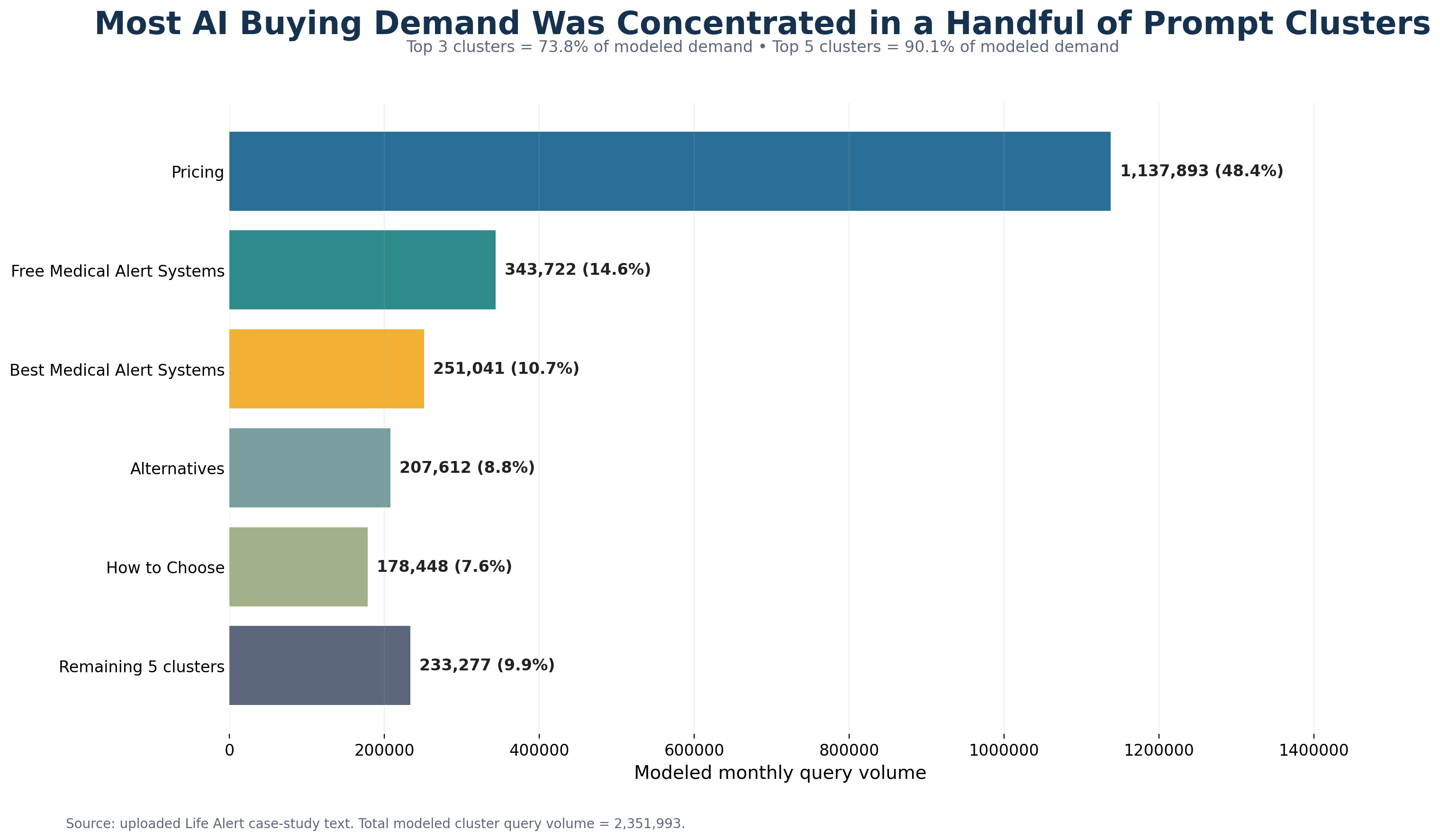
Across all ten clusters in the Life Alert packet, Pricing accounted for 48.4% of total modeled demand. The next largest clusters were Free Medical Alert Systems at 343,722 queries or 14.6%, Best Medical Alert Systems at 251,041 or 10.7%, Alternatives at 207,612 or 8.8%, and How to Choose a Medical Alert System at 178,448 or 7.6%.
That means Pricing alone carried more modeled demand than the next three clusters combined. When the report says this is the largest directional exposure zone, it is not speaking loosely. Nearly half of measured demand sat in a cluster where Life Alert was visible but never advanced.
The Pricing Evidence Layer Was Dominated by Third-Party Sources
The pricing cluster was not shaped primarily by Life Alert's own domain. It was shaped by external sources that AI systems relied on to explain price, value, and category comparisons.
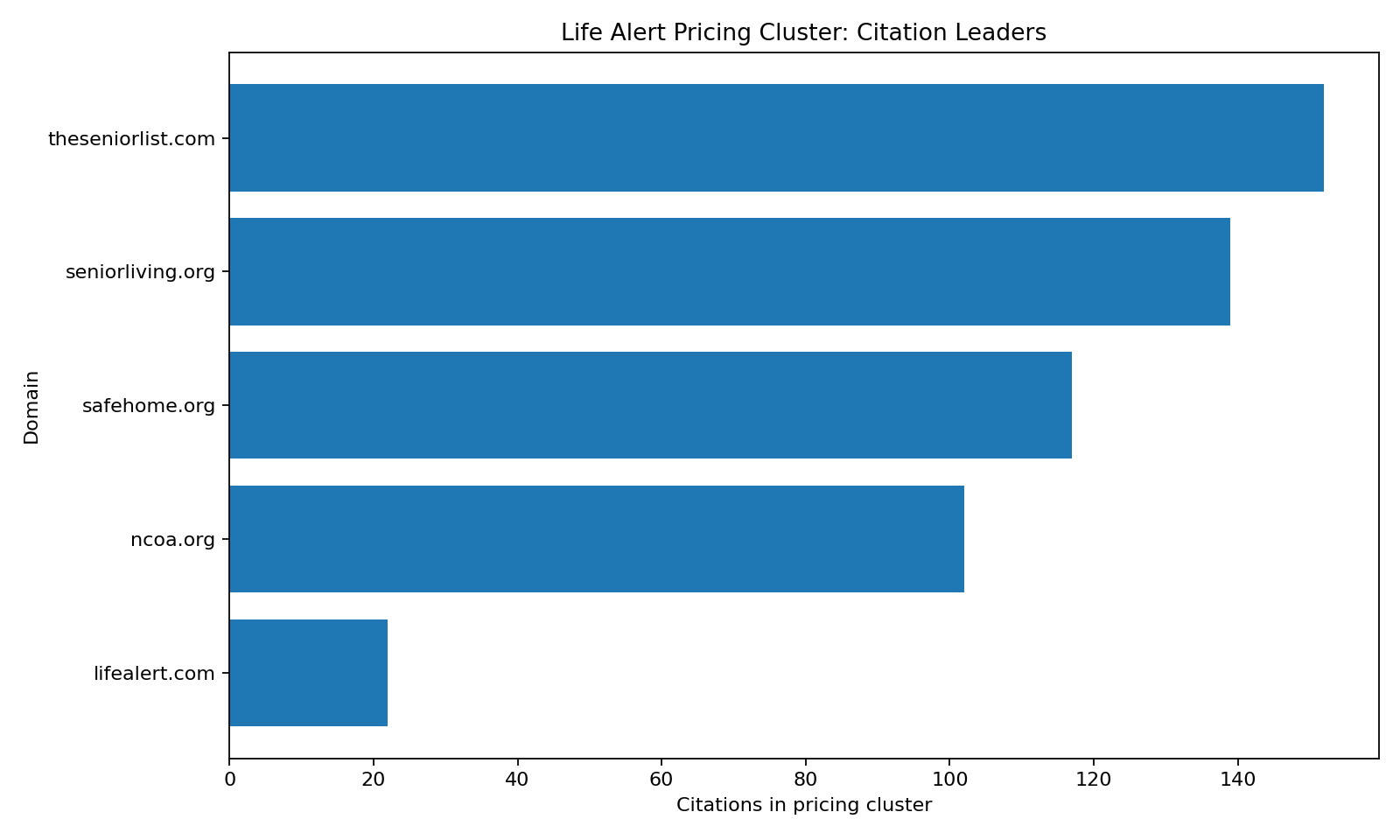
The reported citation leaders in the pricing cluster were:
- theseniorlist.com: 152 citations
- seniorliving.org: 139 citations
- safehome.org: 117 citations
- ncoa.org: 102 citations
- lifealert.com: estimated 22 citations
That gap is large enough to matter on its own, but the more important point is what those sources were doing. In this cluster, AI systems were constructing pricing answers from comparative editorial and nonprofit frames, not from Life Alert's own pricing narrative.
Why Pricing Visibility Did Not Become Recommendation Eligibility
The report gives a direct reason: Life Alert's pricing content in C03 was described as non-transparent.
That is the key cluster-level narrative risk. The issue was not only that editorial sources had more citations than lifealert.com. It was that the official pricing narrative itself was not strong enough to survive comparative scrutiny. In high-intent pricing prompts, that matters more than raw presence.
So the pricing problem had two layers at once:
- External authority gap Third-party editorial and nonprofit domains dominated the citation environment.
- Narrative qualification gap Life Alert's own pricing content was described as non-transparent, weakening its ability to become recommendation-supportive even when cited.
That is why pricing was classified as moderately recoverable rather than easily recoverable.
A Supplemental Directional View: Price-Led Defection Prompts
The supplemental 919-observation directional packet sharpens the same story, but it should be read as supplemental context rather than as the primary source of truth.
That packet describes Pricing as the highest-volume cluster to highlight and frames it as the place where Life Alert's brand awareness becomes a commercial liability. It also identifies "cheaper alternative to Life Alert" as a major price-led defection query and says that pricing opacity, contract rigidity, and feature gaps recur in negative answer-layer framing.
Those directional examples support the pricing case-study logic. But the core claim on this page does not depend on them. The April 2026 baseline already shows enough: the largest cluster in the report, substantial presence, zero recommendation capture, and a citation environment led by third-party sources.
What This Cluster Proves About AI Buying Journeys
Pricing is often treated as a late-stage filter, but in AI-mediated discovery it behaves like a recommendation gate.
A brand can be known, mentioned, and even repeatedly surfaced in pricing prompts, yet still fail to become recommendation-qualified if the evidence layer is built by other domains and the official price narrative is weak. The Life Alert pricing cluster demonstrates that clearly:
- visibility was real
- demand concentration was massive
- recommendation capture was zero
- owned-domain support was materially weaker than the editorial layer
- the official pricing narrative itself was not helping enough
That combination makes Pricing the cleanest cluster-level example of how AI recommendation control differs from simple brand recognition.
Methodology
Primary source of truth
This page uses the April 2026 Life Alert baseline report as the primary evidence set. The full packet covers 1,026 prompts, 10 high-intent clusters, 6 AI platforms, and 2,351,993 total modeled cluster query volume. This page isolates the Medical Alert System Pricing cluster for deeper analysis.
Cluster logic
The pricing cluster is one of ten commercial-intent clusters in the baseline. It covers cost, affordability, comparative pricing, and related price-led buying prompts. Cluster findings should be interpreted inside the cluster itself, not as interchangeable with the full market.
Metric logic
This page keeps presence rate, AI recommendation share, ranking capture, citation counts, share of demand, and recoverability separate. It does not invent blended scores. It also does not convert directional exposure into dollar-value claims, because the supplied economics layer does not populate those fields.
Citation logic
Citation analysis focuses on which domains shaped the pricing answer set. The goal is not simply to count mentions, but to understand which source environments AI systems relied on when framing pricing guidance.
Supplemental evidence
Some prompt-level examples and competitive framing language can be illustrated with the separate 919-observation directional packet. That packet is lead-generation oriented and explicitly notes thinner coverage in some clusters, so it is used only as supplemental context on this page.
Limitations
This is a single-month baseline, not a trend study. It should be read as a point-in-time view of the pricing cluster in April 2026.
The baseline report does not provide a full competitor market-wide pricing share table. Any named competitor observations outside the baseline should therefore be treated as directional.
The pricing page also does not claim realized revenue loss, value at risk, or commercial attribution. The underlying packet supports exposure analysis, not monetized outcome modeling.
FAQ
Why create a separate pricing case study if there is already a flagship case study?
Because Pricing is the single largest demand pool in the entire baseline. A flagship page proves the overall thesis. A pricing page proves where the thesis matters most commercially.
Was Life Alert absent from pricing prompts?
No. Life Alert appeared in 55.71% of pricing prompts. The problem was not absence. The problem was zero recommendation and ranking capture inside the largest demand pool.
What made the pricing cluster different from the others?
Scale. At 1,137,893 modeled queries, Pricing represented 48.4% of total measured demand. No other cluster came close.
Did Life Alert's own domain appear in the pricing cluster?
Yes, but weakly relative to the leading citation layer. The report estimates 22 citations for lifealert.com, compared with 152 for theseniorlist.com, 139 for seniorliving.org, 117 for safehome.org, and 102 for ncoa.org.
Does this page claim revenue loss?
No. It uses demand concentration and directional exposure only. The supplied economics fields do not support monetized attribution.
Final Thoughts
Get your free report to see how LLM Authority Index separates demand concentration, presence, recommendation share, citation architecture, and recoverability inside AI buying journeys.
Related Pages
Keep reading
Related case studies
Case Study
The Visibility Trap: How AI Share of Voice Made a Brand Look Like It Was Winning While AI Was Sending Buyers Elsewhere
Methodology case study: share-of-voice–style scoring suggested strength in comparison and pricing, while sentiment-gated recommendation analysis showed 0% capture and cautionary framing—why the strategic diagnosis inverted.
ReadCase Study
Life Alert in AI Search: Visible, but Not Recommendation-Qualified
Life Alert entered AI-mediated consideration, but not AI-mediated preference. In the April 2026 LLM Authority Index baseline, the brand appeared in just over half of measured AI responses across six major platforms. That confirms broad recognition. But the outcome layer was absent: no measurable recommendation share, no measurable Top 1, Top 3, or Top 10 capture, and no measurable conversion from mention into ranked inclusion. This was not a discovery failure. It was a recommendation-qualification failure.
ReadCase Study
Life Alert's Citation Architecture in AI Search: Why Visibility Did Not Become Recommendation
April 2026 analysis of Life Alert across 1,026 prompts, 10 high-intent clusters, and 6 AI platforms. The core finding: third-party editorial and trust sources shaped the recommendation layer, while Life Alert's own domain remained too weak, narrow, or reference-only to change purchase guidance.
Read